A gutter system is one of the simplest components on a home and one of the most consequential when it fails. Most homeowners think about gutters in the context of overflowing water or clogged debris — a nuisance, but manageable. What they don’t think about is what’s happening at the base of the home while water is pooling in the wrong places, season after season, year after year.
Foundation damage caused by a failing gutter system is one of the most expensive repair categories in residential construction. It’s also one of the most preventable. The problem rarely announces itself until it’s already significant — a crack in the basement wall, a door that won’t close squarely, a floor that’s no longer level. By that point, what started as a $500 gutter installation error has compounded into a repair scope that can run $10,000 to $50,000 or more depending on how far the damage has progressed.
A 2025 survey by LeafFilter found that 4 in 10 homeowners have experienced damage to their home from clogged or poorly maintained gutters — and that figure only captures the damage homeowners noticed and attributed correctly. The slow, invisible foundation damage that a poorly installed gutter system causes often goes unrecognized for years.
Here’s exactly how that damage happens, what installation mistakes cause it, and what a correctly installed gutter system looks like.
What a Gutter System Is Actually Supposed to Do
Before getting into how a gutter system fails, it helps to understand what it’s designed to accomplish. Every rainfall event dumps a significant volume of water onto your roof — on a typical Staten Island home with 1,500 square feet of roof surface, a one-inch rainfall deposits nearly 1,000 gallons of water. The gutter system’s job is to collect that water at the eave, channel it to downspouts, and discharge it safely away from the home’s foundation.
When that system is working correctly, the soil around the foundation stays at a consistent moisture level. The structural integrity of the foundation is preserved. Water never has a reason to interact with the foundation walls at all. The entire process is invisible precisely because it’s working.
When the gutter system fails — through poor installation, inadequate sizing, incorrect slope, or improper downspout placement — that thousand gallons per rainfall event goes somewhere else. And where it goes is almost always directly toward the foundation.
The 7 Installation Mistakes That Lead to Foundation Damage
Incorrect Gutter Slope
A gutter system is not installed level. It’s designed to slope toward the downspout at a rate of approximately half an inch for every ten linear feet of run. This slope is what causes water to flow toward the drain point rather than sit in the channel.
When gutters are installed too flat, water pools in the channel rather than draining. That pooled water overflows during rainfall — directly over the edge of the gutter and down the face of the home’s exterior, landing at the foundation. Over time, the standing water also adds significant weight to the gutter, accelerating sagging and fastener failure. If the slope is too shallow, water can sit and pool; if it’s too steep or uneven, water may overshoot the gutter or cause sections to sag.
Undersized Gutters for the Roof Surface
Gutter sizing isn’t arbitrary. The volume of water a roof sheds during a heavy rainfall — the kind that Staten Island sees regularly from spring storms and late-season nor’easters — requires a gutter system with sufficient capacity to handle the peak flow without overflowing.
Standard 4-inch gutters are inadequate for most modern homes. A properly sized gutter system for an average Staten Island house typically requires 5-inch or 6-inch gutters, and the sizing should account for the specific roof pitch and total drainage area feeding each gutter run. An undersized gutter system works fine in light rain and overflows in the heavy events — precisely when the correct function matters most.
Downspouts That Discharge Too Close to the Foundation
This is the single most common installation error and the most direct cause of foundation damage. If downspouts dump water just a few inches from the foundation, that water can seep into the soil, create hydrostatic pressure, and lead to cracking or shifting.
Industry standards and most building codes require downspout discharge to terminate at least four to six feet from the foundation. Many contractors and guidelines recommend extending that distance to ten feet for optimal protection — particularly in climates like New York’s where heavy seasonal rainfall concentrates water delivery to short periods.
On many Staten Island homes, downspouts terminate with a short elbow that drops water six inches from the foundation wall. Every rainfall, hundreds of gallons of water discharge directly against the soil at the most critical point of the home’s structure.
Too Few Downspouts
The standard recommendation is one downspout for every 30 to 40 linear feet of gutter run. Homes with longer walls, complex rooflines, or larger drainage areas need more. A gutter system with insufficient downspout capacity creates bottlenecks — water backs up in the channels, overflows at the lowest points, and again finds its way to the foundation rather than away from it.
Improper Fastening and Sagging Sections
Gutters that are not secured with enough hangers — or that use inadequate fastener hardware — sag over time under their own weight and the weight of water and debris. A sagging section creates a low point that collects standing water, adds stress to adjacent fasteners, and eventually pulls the entire gutter away from the fascia board. Once the gutter separates from the fascia, water runs behind it rather than through it, reaching the soffit, the wall sheathing, and ultimately the foundation.
Missing or Blocked Gutter Guards in High-Debris Environments
Staten Island’s residential neighborhoods are heavily treed. Oak, maple, and other deciduous trees drop enormous volumes of leaves, seeds, and debris into gutters every fall. A gutter system without guards in this environment requires cleaning two to four times per year to maintain free flow — and most homeowners don’t do it that frequently. A 2025 survey found that 41% of homeowners clean or inspect gutters once or twice a year, while 27% wait until a problem arises. Blocked gutters overflow constantly during fall and winter storm events, when water volume is highest and the damage compounds fastest.
Poor Site Grading at the Downspout Discharge Point
Even a correctly installed gutter system can cause foundation damage if the ground grading at the discharge point works against it. The soil around a home’s perimeter should slope away from the foundation at a minimum of one inch per foot for the first six feet. When the grade is flat or slopes toward the home, even properly discharged water from the downspout pools against the foundation rather than draining away. A gutter system upgrade that doesn’t address the grading problem at discharge points solves only part of the issue.
How Water Destroys a Foundation — The Mechanism
Understanding why this matters requires understanding what water does to foundation materials over time.
Hydrostatic Pressure
Hydrostatic pressure occurs when water saturates the soil surrounding the foundation and begins pushing against the basement walls. This pressure can cause concrete walls to crack or bow inward. Poorly installed gutters often contribute to hydrostatic pressure because they allow water to collect directly around the foundation perimeter instead of dispersing it safely away from the home.
Hydrostatic pressure builds gradually and invisibly. By the time it produces visible cracks in basement walls, the pressure has been working on the structure for an extended period.
Soil Erosion and Settlement
Water that repeatedly falls or flows in the same area around the foundation washes away the compacted soil that supports the foundation footing. As that soil erodes, the foundation loses its bearing support unevenly. Differential settlement — where one section of the foundation sinks more than another — produces the staircase cracks, sloping floors, and sticking doors that are the visible symptoms of serious foundation movement.
Freeze-Thaw Amplification
On Staten Island, water that saturates the soil around the foundation doesn’t just sit there — it freezes in winter and expands by roughly 9% in volume. That expansion pushes against foundation walls and into any cracks that have already formed, widening them with each cycle. During winter, absorbed water can freeze and expand, creating small cracks that grow larger over time. Repeated freeze-thaw cycles accelerate foundation deterioration and can lead to costly structural repair projects. The New York metro area delivers dozens of these cycles in a typical winter — enough to turn hairline cracks into structural problems across a single season.
Basement Water Intrusion
Once the foundation develops cracks from hydrostatic pressure or freeze-thaw damage, water finds its way through. Basement flooding, efflorescence on walls, persistent dampness, and mold growth in below-grade spaces are all downstream consequences of a gutter system that isn’t managing water correctly at the roof. What started at the roofline ends up in the living and storage space of the home.
What the Damage Costs When It Gets There
Foundation repair is among the most expensive categories in residential construction. Crack injection and waterproofing for minor damage typically runs $3,000 to $8,000. Wall stabilization for bowing or cracked basement walls ranges from $5,000 to $15,000. In cases involving significant settlement, underpinning or pier installation to re-level and stabilize the foundation can reach $20,000 to $50,000 or more.
All of it traces back to water management. All of it was preventable with a correctly installed and maintained gutter system.
Our exterior structural services address the full range of water damage consequences — from foundation crack repair to stoop and retaining wall reconstruction — but the better outcome is never needing them because the gutter system was installed correctly in the first place.
What a Correctly Installed Gutter System Looks Like
A properly installed gutter system for a Staten Island home meets these specifications:
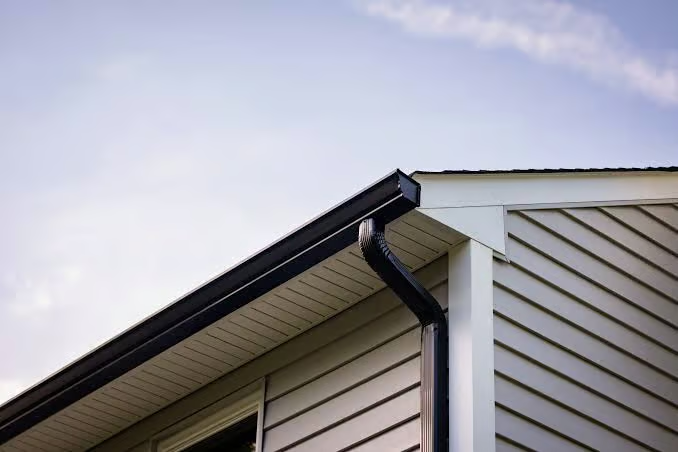
Gutters sized at 5 or 6 inches for most residential applications, matched to the roof’s total drainage area and pitch. Slope consistent at half an inch per ten feet toward each downspout throughout the entire run. Hangers spaced no more than 24 inches apart, using screws rather than spikes for secure long-term fastening. Downspout placement at every corner and at least every 30 to 40 feet along longer runs. Downspout extensions that discharge water a minimum of six feet from the foundation, preferably ten feet, directed toward a natural drainage path or connected to an underground drainage system. Sealed joints at all seams and connections to prevent leaking behind the gutter. Site grading that slopes away from the home at the discharge points.
A gutter system that meets all of those specifications can perform for 20 to 30 years with regular cleaning and minor maintenance — protecting the foundation throughout that entire period.
Our roofing installation services include gutter assessment and installation coordination as part of a complete exterior scope. For homeowners who need stoops, retaining walls, or exterior masonry addressed alongside drainage improvements, our brick and blockwork team handles the full range of exterior structural work.
The Right Time to Assess Your Gutter System
Spring and early fall are the best times to evaluate a gutter system — after winter stress has revealed any damage and before the next heavy rainfall season arrives. Walk the perimeter of your home during a rainstorm if possible and watch where the water actually goes. Water sheeting off the fascia rather than through the gutter, overflow at any point in the run, or discharge pooling near the foundation are all signs that the system needs attention before it causes damage that runs far beyond what the gutters themselves cost to fix.
At Albatros Construction, we handle exterior and structural work across Staten Island — from roofing and exterior services to residential renovations that include basement waterproofing and structural repair. If your home has signs of water intrusion, foundation cracking, or a gutter system that isn’t performing, contact us for a free estimate.
You can also browse our completed projects to see the range of exterior and structural work we’ve completed across the borough.
The foundation your home sits on is worth protecting. A correctly installed gutter system is one of the most cost-effective ways to do it.
Albatros Construction Inc. is a licensed general contractor serving Staten Island, NY. We specialize in exterior structural work, roofing, masonry, residential renovations, and foundation-related repairs.