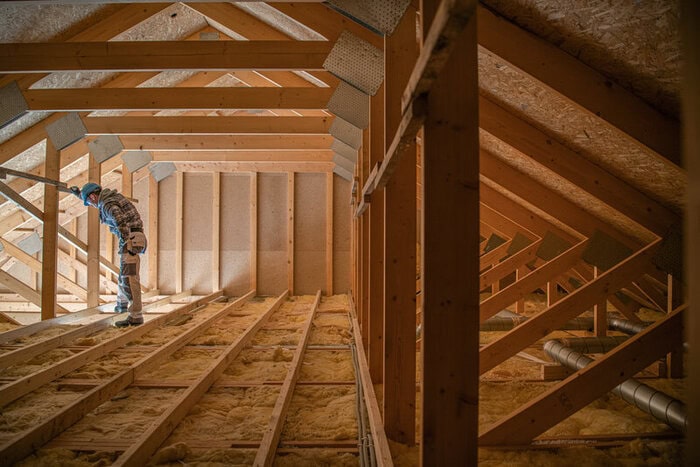
Attic insulation is the least visible component of a home’s roofing system and consistently the most underestimated. Most homeowners think of it as a comfort upgrade — something that makes the upstairs bedroom a little less hot in August. The reality is more consequential than that. Attic insulation sits at the intersection of three systems that determine how long your roof lasts, how much your energy bills run, and how comfortable your home stays year-round. When it’s working correctly, it’s invisible. When it’s failing, the damage shows up in every utility bill and eventually in the roof itself.
On Staten Island, where homes endure genuine four-season stress — humid summers pushing attic temperatures past 130°F, winters delivering repeated freeze-thaw cycles and ice dam risk — the condition of the attic insulation is never a trivial question. Here’s what it’s actually doing, what happens when it isn’t doing it well, and what the right attic system looks like for a home in this climate.
What Attic Insulation Is Actually Doing
Insulation’s job is thermal resistance — slowing the movement of heat through the building envelope. Heat always moves from warmer areas to cooler ones until temperatures equalize. In winter, that means warm indoor air is constantly trying to escape upward through your ceiling and into the cold attic. In summer, it means the 130°F to 150°F heat building up in your attic is constantly trying to push downward into your living space.
Attic insulation creates friction in that process. The higher the R-value — the standard measurement of thermal resistance — the more effectively the insulation slows that heat movement. The Department of Energy assigns recommended R-values by climate zone. For Staten Island, which falls in Climate Zone 4, the DOE recommends R-49 to R-60 for attic floors in homes that currently have little or no insulation, and R-38 to R-49 when adding insulation to an already-insulated attic.
Older Staten Island homes — and there are many, given the borough’s established housing stock — commonly test at R-19 or R-30, which is well below what current standards require. At those levels, the attic insulation is doing a fraction of the thermal work it should, and the home is paying for that shortfall in energy costs every month.
The Energy Bill Impact: What the Numbers Say
The savings from properly upgraded attic insulation are consistent across multiple independent research sources and represent one of the strongest returns on investment in residential energy efficiency.
ENERGY STAR, citing DOE methodology, estimates that homeowners who combine air sealing with upgraded attic insulation save an average of 15% on annual heating and cooling costs. The EPA puts the combined figure at up to 20% when the full home envelope is addressed. For a Staten Island household spending $2,400 per year on heating and cooling — which is conservative given New York electricity rates — that’s $360 to $480 in annual savings that compound across the life of the improvement.
The math on the investment is straightforward. A professional attic insulation upgrade, including air sealing, typically runs $1,500 to $5,000 depending on attic square footage, existing insulation condition, and material type. At $400 in annual savings, that investment pays back in four to twelve years — and the insulation continues performing for 20 to 30 years beyond that. Unlike most home improvements, attic insulation delivers its return automatically, every year, without any ongoing action required.
What makes the savings consistent is that attic insulation addresses the single largest heat loss point in most homes. Heat rises. The attic accounts for 20% to 25% of total heat loss in a typical house — more than walls, more than windows, more than floors. Addressing it first delivers the highest energy return per dollar of any insulation upgrade available.
How Attic Insulation Affects Your Roof — Not Just Your Bills
The connection between attic insulation and roof performance is less understood by most homeowners, but it’s equally important.
Ice Dams: The Winter Consequence of Poor Insulation
Ice dams are one of the most destructive winter phenomena on Staten Island roofs, and attic insulation is directly responsible for whether they form. When a poorly insulated attic allows warm interior air to heat the roof deck from below, snow on the roof melts — even in freezing temperatures. That meltwater runs down the slope until it reaches the cold eave overhang, where it refreezes into a ridge of ice. Subsequent snowmelt backs up behind that ice ridge, and water forced under the shingles enters the home.
A properly insulated attic keeps the roof deck close to outside air temperature. With no internal heat source warming the deck, snow melts evenly across the roof rather than selectively — and ice dams don’t form. The same attic insulation upgrade that lowers your heating bill directly eliminates one of the leading causes of winter roof and interior water damage in this climate.
Moisture and Roof Deck Deterioration
Warm, humid air rising from the living space carries moisture with it. In a properly insulated and ventilated attic, that moisture moves through and exits via the exhaust ventilation. In an under-insulated attic where warm air is constantly entering and losing heat against the cold roof deck, moisture condenses on the decking and framing — the same process that forms condensation on a cold glass in summer.
Over time, that condensation promotes mold growth, causes wood rot in the roof deck and structural members, and accelerates the deterioration of roofing materials from below. It’s a form of damage that builds invisibly across multiple seasons and typically isn’t discovered until a roofing or attic project opens the space and exposes what’s been happening.
Shingle Lifespan and Thermal Stress
In summer, heat that builds up in the attic radiates upward through the roof deck and contributes to thermal stress on the shingles from below, compounding the solar heat they’re absorbing from above. A well-insulated attic reduces this bidirectional heat stress, extending the effective lifespan of the shingles. Most manufacturers specify ventilation and insulation requirements in their warranty terms — a roof that’s installed over an attic system that doesn’t meet those requirements can void coverage even if the shingles themselves are defect-free.
Our roof replacement and installation team always evaluates attic conditions as part of any roofing scope because a new roof installed over a failing insulation system will underperform and age prematurely regardless of shingle quality.
The Air Sealing Factor: Why Insulation Alone Isn’t Enough
One of the most common reasons attic insulation upgrades underdeliver on their expected savings is that the insulation is added without addressing air sealing first. These are two different things that work together.
Insulation slows heat transfer through solid materials — it creates thermal resistance. Air sealing closes the physical gaps and penetrations where conditioned air actually moves between the living space and the attic in bulk. Recessed light housings, plumbing penetrations, attic hatch frames, top plates, bath fan connections, and wiring holes are all common air leakage points. ENERGY STAR describes air leakage as the “silent killer” of energy efficiency — a home can have adequate R-value insulation and still lose a significant portion of its conditioned air through gaps the insulation sits above but doesn’t seal.
When air sealing and attic insulation are addressed together, they eliminate both the bulk air movement and the conductive heat transfer. The combined result is what produces the 15% to 20% savings figures the research documents. Doing one without the other is like insulating a room but leaving a window open.
Our attic remodeling service addresses both components — insulation and air sealing — as a system, not as separate scopes. That’s the approach that delivers the energy performance homeowners expect.
Insulation Types and What Works Best in Staten Island
There’s no single best attic insulation material for every situation. The right choice depends on the attic’s geometry, the existing condition, budget, and specific performance goals.
Blown-in fiberglass or cellulose is the most cost-effective option for standard attic floors with accessible, open joist bays. Both materials install quickly, achieve consistent coverage without compression risk, and deliver strong R-value per inch. Cellulose — made primarily from recycled paper — fills irregular spaces and around obstructions better than batts and is a popular choice for adding depth to existing partial insulation. This approach typically runs $1,500 to $3,500 for an average Staten Island attic.
Spray foam offers the highest R-value per inch and doubles as an air barrier — sealing and insulating in a single application. It’s particularly effective in attics with complex geometry, multiple penetrations, or where moisture control is a specific concern. Closed-cell spray foam applied to the roof deck creates a conditioned attic in which the entire attic space is within the thermal envelope of the home — which is the preferred approach when HVAC equipment or ductwork runs through the attic. The cost is higher, typically $3,000 to $7,000 for a residential attic, but the dual function of insulation and air sealing simplifies the scope and often delivers faster payback in energy-intensive environments.
Fiberglass batts work well in open, consistently spaced joist bays and are a common choice for DIY projects. Their limitation is installation sensitivity — gaps, compression, or improper facing orientation all reduce effective R-value significantly. In professional installations where coverage can be controlled carefully, they perform to specification.
Signs Your Attic Insulation Needs Attention
Most Staten Island homeowners don’t think about attic insulation until a problem is visible — by which point it’s already been affecting the home’s performance for years. These are the indicators worth paying attention to:
Energy bills that have increased meaningfully year over year without a change in usage habits. Upper-floor rooms that run noticeably warmer in summer or colder in winter than the rest of the house. Ice dams forming along the eaves during or after winter storms. An HVAC system that runs longer cycles or more frequently than it used to. Visible mold, staining, or moisture damage on attic framing when you access the space. Insulation that appears flat, compressed, wet, or patchy rather than full and even.
Any one of these signs warrants an assessment. When a roofing project is already planned, that’s the ideal time to address attic insulation simultaneously — the two scopes share access and inspection work, and ensuring the new roof starts its life above a properly insulated and sealed attic protects both investments.
The Right Time to Upgrade
The best time to evaluate and upgrade attic insulation is before your next roofing project — or during it. Coordinating both allows the attic to be assessed, sealed, and insulated while the roofing work is underway, eliminating redundant labor and ensuring that the new roof is installed over a system that’s ready to support its full designed performance.
At Albatros Construction, we handle both scopes. Our attic remodeling team assesses existing insulation depth, identifies air sealing deficiencies, and specifies the right insulation approach for each home’s specific layout and performance goals. When coordinated with a roof replacement, the combined project delivers the most complete and cost-effective result.
If you’re noticing any of the warning signs above, or if your home is more than 15 years old and the attic has never been professionally assessed, contact us for a free estimate. We’ll evaluate the full system — insulation, air sealing, ventilation — and give you a clear picture of where the home is losing performance and what it takes to fix it.
You can also browse our residential renovation services and completed construction projects to see the full scope of work we do across Staten Island.
Albatros Construction Inc. is a licensed general contractor serving Staten Island, NY. We specialize in roofing installation and replacement, attic remodeling, residential renovations, and exterior structural work.